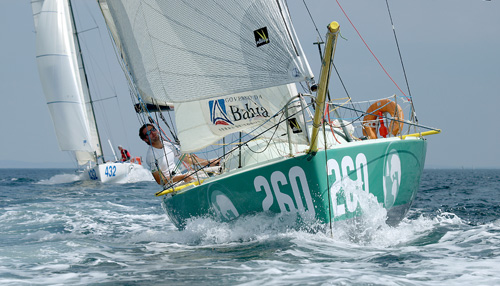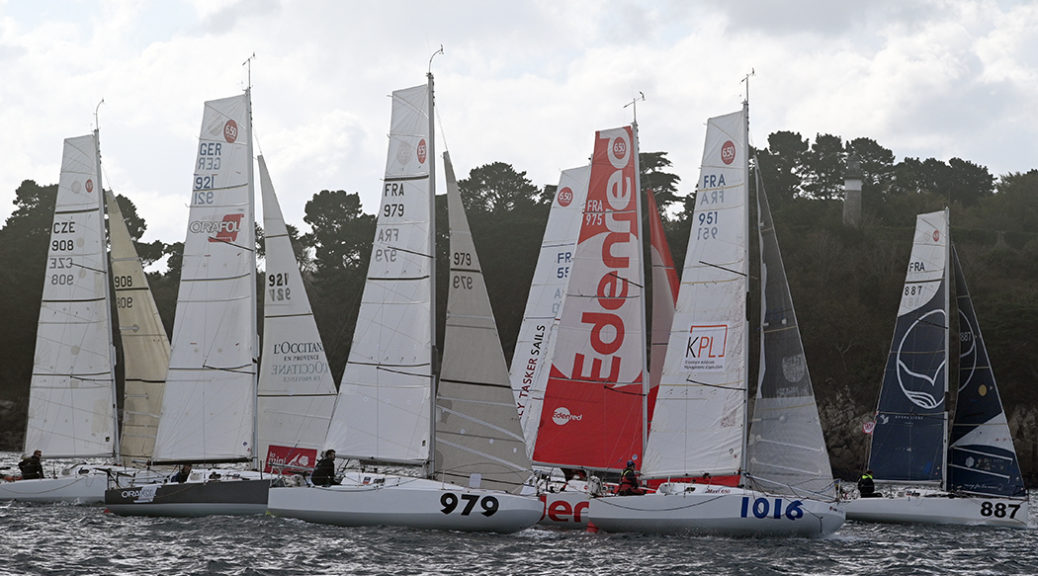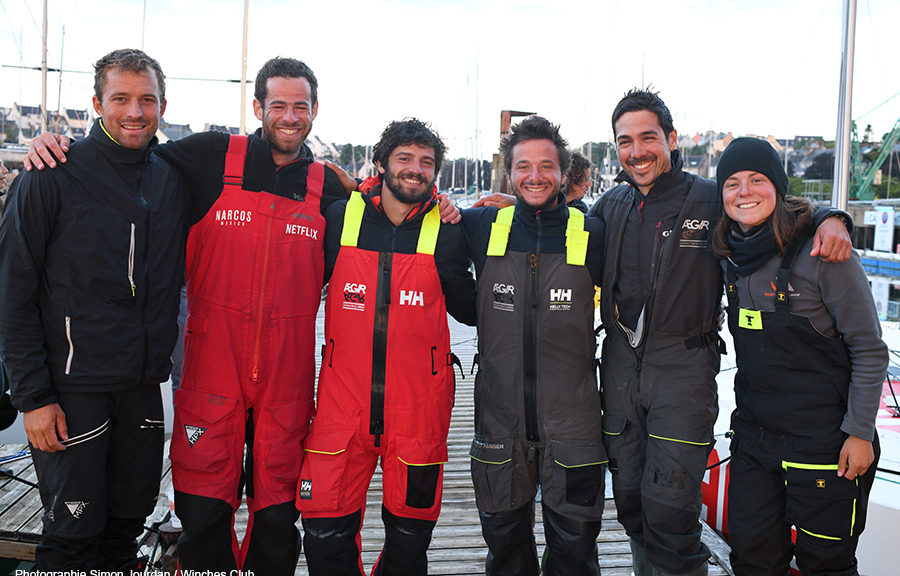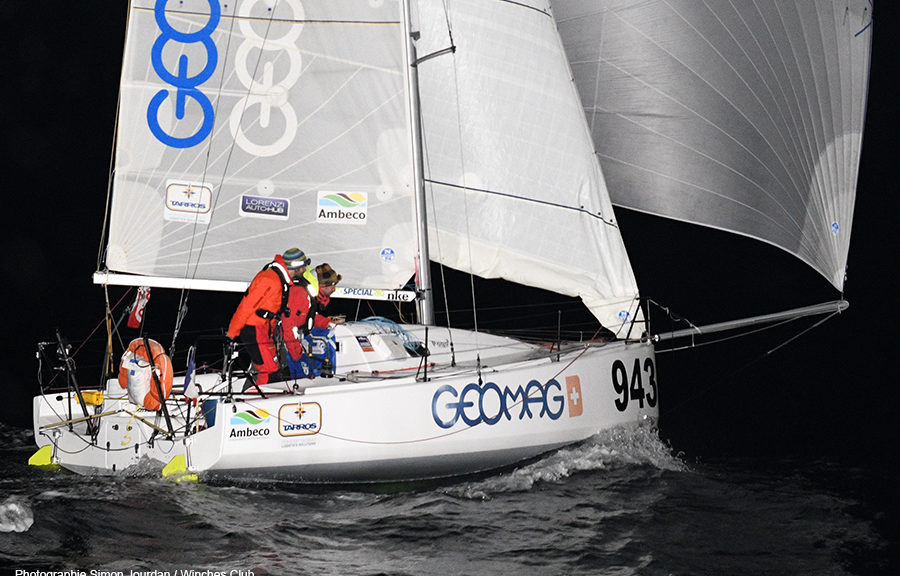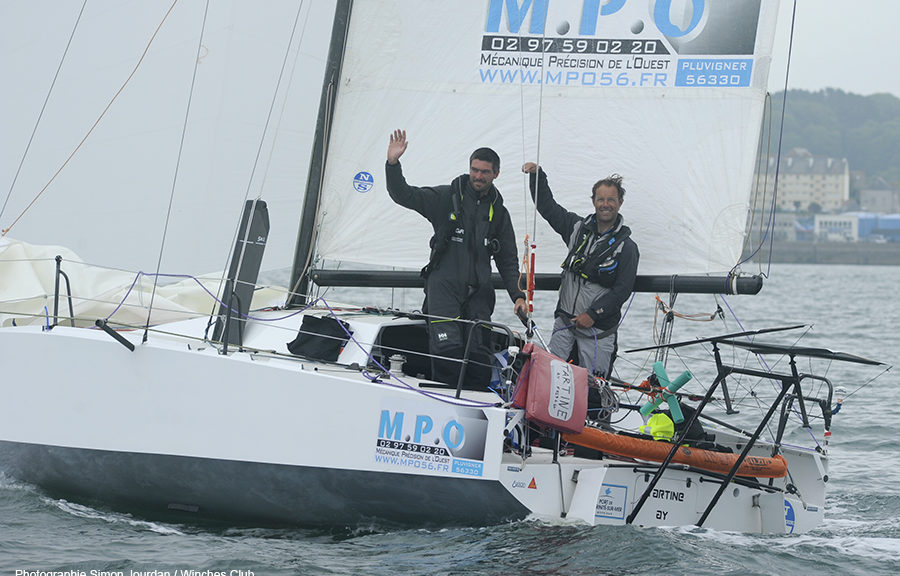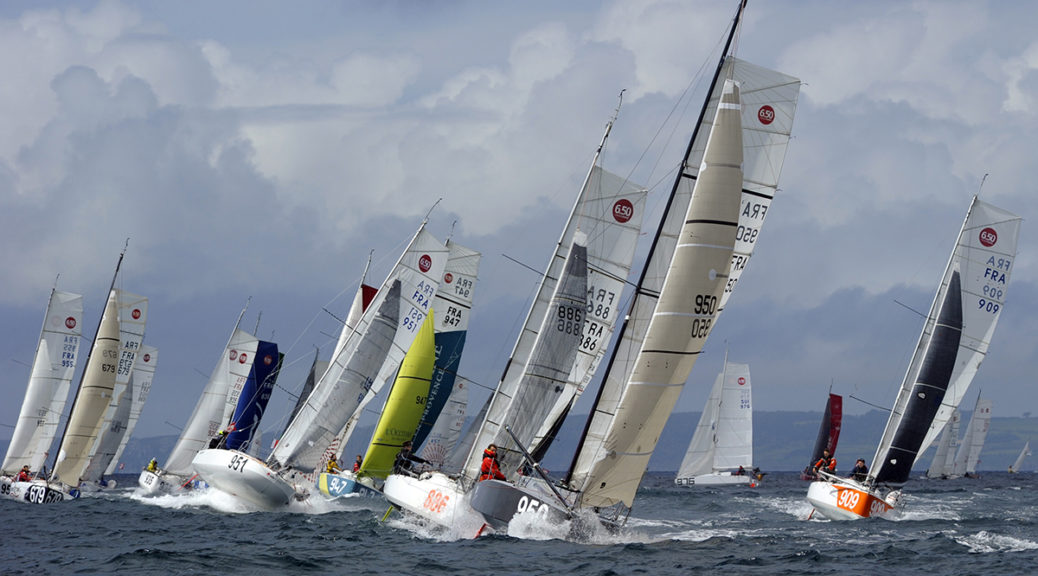
From end of May, the Mini 6.50, these mini offshore sailing boats with a reduced crew, will assemble in Douarnenez for two big races : the Marie-Agnès PéronTrophy, a challenge of the « French Championships of Solo Offshore Racing – Mini 6.50 » and the Mini-Fastnet. Continue reading THE SEASON OF THE MINIS IN DOUARNENEZ
Nearly June !
We find ourselves a little more than a month from the departure of the Marie-Agnès Péron Trophy, the first of two Mini races leaving from Douarnenez. The Plastimo-Lorient, which raced during confinement, has just finished and saw Hugo Dhallenne and Thibault Vauchel Camus win in Series (979), plus Pierre le Roy and Cédric Faron winning with the imperial prototype 1019, Réseau étincelle.
The Marie-Agnès Péron Trophy and the Mini-Fastnet have been placed on the list of priority competitions by the French Sailing Federation and should take place on the dates concerned under a protocol adapted to the health situation; less convivial perhaps but the warmth and good spirits of the Winches Club volunteers will still be present!
Dozens of boats are on the waiting list. And the organisation has just allowed 4 extra places, carrying the number of registrations for each race to 84. The competitors can’t wait to get to Douarnenez in June. Which makes for a very promising season.

35th MINI FASTNET
35th MINI FASTNET
French Duo Racing of 600 nautical miles

Departure 13 June, 2021
Awards 19 June, 2021
International Double Race of 600 nautical miles
Douarnenez – Fastnet Lighthouse – Douarnenez
The Mini-Fastnet organised since 2002 by the Winches Club.
Mini-Fastnet… 600 nautical miles to enter in Mini Class history. Four unforgettable days and nights to approach the legendary light of the Fastnet. A race to be shared as a real proof.
So, absolute to integrate the Mini circuit threw this race.
The course (approximatively 600 nautcal miles) :
Douarnenez – Chenal du Four – Wolf Rock – Racon, East of Scilly – Stags – Fastnet Lighthouse – Douarnenez.
The registration is open here
An exceptional race.


Results of Mini-Fastnet 2019
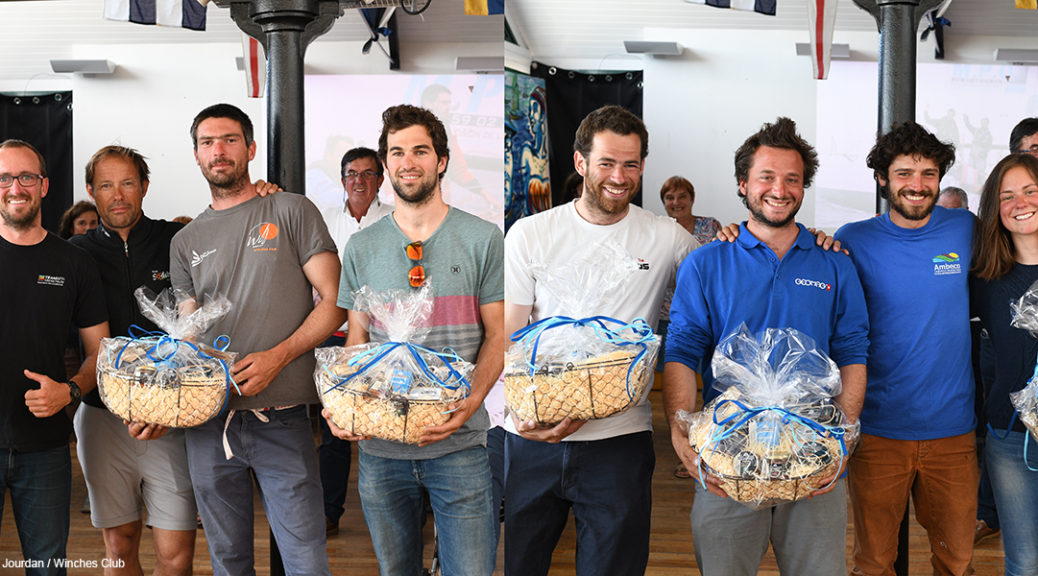
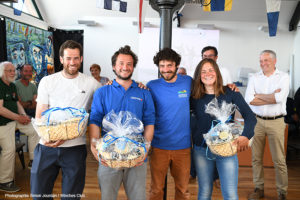
The podium in series
5h58m00s Thursday June 20: Nicolas D’Estais and Sam Goodchild, on the 905, finished at the second place.
Nicolas D’Estais: “I’ve never been so fast, the way up to the Fasnet was pretty rough. I learned a lot from Sam”. Super happy with the result, he remembers his teammate’s philosophy: “At one point, we spent more than 4 hours without seeing anyone… Sam reassured me that you can’t be overtaken by an entire fleet without realizing it!”
Sam Goodchild is a team member of Thomas Coville and is delighted with this first Mini experience.
6h18m37s Thursday, June 20: Amélie Grassi and Davy Beaudart, on the 944, crossed the finish line, at the third place.
Amélie: “They were solid” when talking about the winners Ambrogio Beccaria and Alberto Riva. After the English Channel, Amélie and Davy quickly realized that there was no Maxi left in front of them. Even if she deplores some mistakes, Amélie is still happy and is sure to have fought well in this race.
On his side, Davy really enjoyed the way up to Fastnet. He is really pleased with the racing conditions, as well as the splendid coastal landscapes of Ireland. He is very happy with this 2019 edition.
The rest of the fleet will continue to arrive until late tonight.
The awards ceremony is scheduled for tomorrow, Friday 21 June at 6:00pm at the “Maison du nautisme” in Tréboul.
First place for Ambrogio Beccaria and Alberto Riva, both surprised!
4h12’38s Thursday June 20: Ambrogio Beccaria and Alberto Riva win the Mini-Fastnet in the series category.
“When we saw the Maxi coming in the English Channel, we said to ourselves, alright, for sure they’ll be in front of us” But Ambrogio and Alberto never saw them again (and for good reasons!). They did their own race, often competing with the prototypes. “A perfect race, but very wet” says Ambrogio ” zero problem, and at the Fastnet it was amazingly beautiful! ».
For Alberto, it was a race for the Maxi, and he is delighted to take his first win on the Mini-Fastnet, after winning the prologue three times.
Ambrogio, for his part, wins the Marie-Agnès Péron Trophy twice in a row and the Mini-Fastnet twice in a row!
A new Mini-Fastnet record
“It was such a fast way up! “says Thomas Coville.
Thomas Coville and Axel Tréhin won the race and set a new Mini-Fastnet record by completing the race in 3 days 4h58’26s at an average speed of 7.86 knots. (The previous record was 3 days 08h52’19s from 2017 and was set by Ian Lipinski and David Raison)
After passing the Fastnet, the duo experienced an electric blackout and sailed without a weather vane or compass from the Irish Sea.
“It was really great, the navigation was amazing. Axel is really very, very strong” said Thomas Coville, obviously delighted with the experience: “It’s an exceptional race, a complete journey”.
“We didn’t eat hot food, crossing the English Channel was very sporty. It was a big fight with François Jambou and Pascal Fievet. They didn’t give up, we had to give everything we had! “said the crew of the 945.

On the pontoon, Axel and Thomas thank Fabio Muzzolini (716) once again warmly for helping them out with a daggerboard just before the start.
Axel Tréhin won his second Mini-Fastnet in a row, it was Thomas Coville’s first attempt.
For François Jambou and Pascal Fievet: “The consolation prize is to be 60 miles ahead of the rest of the fleet! ». They are of course a little disappointed: “I tried everything and I didn’t find the solution,” François said. There was also some little damages on the 865: a winch torn off and the daggerboards stuck.

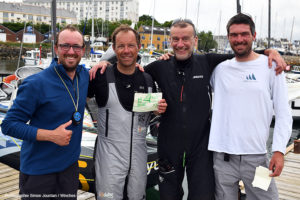
On the pontoon of Tréboul, the four sailors enumerated their many interactions throughout the race, which was intense from one end to the other. “We couldn’t reach Ireland any faster”, according to François. Axel agrees.
François Jambou and Pascal Fievet completed their Mini-Fastnet in 3 days 5h58’20s, at an average speed of 7.76 knots.
These two crews arrive with a huge lead over the fleet. But the race continues! The next arrivals are expected in the middle of next night. We notice that in the series, Ambrogio Beccaria and Alberto Riva on the 943 have manoeuvred with a master hand and have a good lead over their competitors.
Safety inspection
One of the main goals of the Class Mini is to move towards more safety while maintaining the very sporty and innovative aspect of the Mini. This mindset, accentuated by stubborn memories of accidents, results in boat-competitor pairs among the safest of offshore racing.
Safety first
While the measurement defines the boat-specific safety systems, the safety inspection allows checking and validating the mandatory safety equipment that the skipper will take during the race. This equipment varies according to the category of the race.
Race are thus classified by the Offshore Special Regulations (OSR) according to the number of miles and the difficulty:
The Marie-Agnès Péron Trophy : OSR 3
The Mini-Fastnet : OSR 2
The Mini-Transat : OSR 1
The Vendée Globe : OSR 0

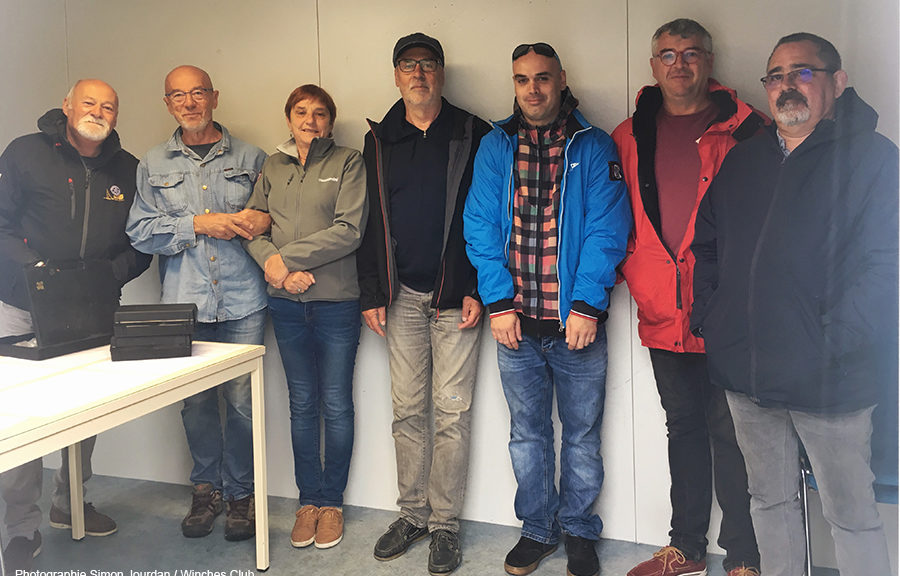
Volunteers are taking care of the inspection
One category separates the Marie-Agnès Péron Trophy from the Mini-Fastnet, so more safety equipment is required for the skippers.
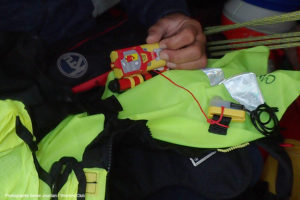
In addition to the life raft, the survival container, the EPIRB beacon, the VHF, nautical documents and many other things, the equipment must notably include 2 TPS suits, an AIS transponder and a personal AIS beacon, a SSB radio, an extended pharmacy and additional survival food rations.

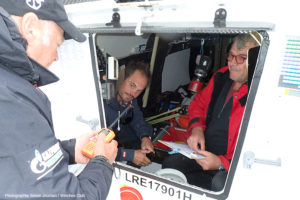
A team of volunteers is performing the safety inspection, open until the day before departure. Starting today (Tuesday), they will inspect more than 80 boats.
The Measurement- Class Mini
At the awards ceremony last Friday, Axel Tréhin, winner of the 15th Trophy Marie-Agnès Péron, pointed out: “The Mini Class rules are pretty well done, look at us, our three boats (the 945, 865, 800 that finished 1st, 2nd and 3rd, respectively) are quite different and yet, there is a hell of a battle at every race! Indeed, the first two arrived less than 5 minutes apart last Thursday.
The Measurement, supervised by Joël Gâté assisted by Annabelle Moreau, is a set of measures and rules that each boat must follow to be admitted to start at the Mini races. First established in 1994 by the board of directors of the Class Mini, the set of rules addresses both performance and safety issues.
The basic principle is that a Mini boat must fit in a box of 6.50 m x 3.00 m x 14.00 m for the proto and 6.50 m x 3.00 m x 12.00 m for the series.

The Mini is a class to experiment and bring innovation to the field of offshore racing, which sometimes leads to funny situations. During checks, we have seen some having to shorten their booms, another one obliged to race with a reefed mainsail, a boat having to set up pumps without connected hoses. The most extreme case was a proto boat, launched a year earlier, which had to been cut in two to expand it. The most spectacular test during these checks is the righting. Lying on the side, we measure, at the head of the mast, whether the force is sufficient to self-righten the boat.
The Class Mini Rule is a set of rules and a clever mix to balance safety, competitiveness and innovation.